lørdag den 14. februar 2009

The architecture of anti-terror

In connection with the exhibition ”Os Dem Demos” [Us Them Demos] Walking Distance is arranging 3 walks inspired by the anti-terror packages and their relation to the judicial, the legislative and the executive powers. We shall confront the anti-terror packages and the authorities by placing ourselves in public spaces – visible, vulnerable and questioning. We wish to raise questions about the consequences that the legislation involves for our freedom of action and our legal rights as citizens and artists.

Meeting-point: In front of Christiansborg Palace Chapel.


On the first “The architecture of anti-terror” tour, which took place by bus, we looked at the administrative authorities involved in carrying out the anti-terror legislation. These include the Danish Immigration Service, the Danish Security and Intelligence Service and other authorities charged with implementing the anti-terror packages. About 50 people participated in the tour. Architect Merete Ahnfeldt-Mollerup was the guide together with Nis Rømer.


Christiansborg was the starting-point for the bus tour. In reaction to 9/11 a majority in the Folketing enacted the anti-terror package in 2002 and later adopted a number of additional provisions in 2006. The anti-terror packages gave expanded powers to the Danish Security and Intelligence Service and the Police in particular, but at the same time it also introduced limitations in the individual citizen’s civil rights.

Architectonically Christiansborg was already outdated when it was built. Rather than expressing the democratic ideas of the day, the architecture reflects the institution of absolute monarchy that the introduction of democracy was designed to break with.


The Supreme Court. It is remarkable that here the threefold division between the legislative, the judicial and the executive powers is cancelled out by the architecture. The home of the Supreme Court is physically attached to Christiansborg. In Denmark there is no other kind of constitutional court, which means that the judiciary has only limited possibilities of controlling laws and the legislators and ensuring the citizens their rights.


The High Court of Eastern Denmark was originally built as an opera house and rebuilt as a court in 1919. Here Fighters+Lovers were given a prison sentence of 6 months for supporting FARC and PLFP. The case has now been appealed to the Supreme Court.


Kastellet, the Copenhagen Citadel, is the home of the Danish Defence Intelligence Service. Section 17.1.1 of the Defence Act states: ”In wartime or under other special circumstances the Defence Minister may without a court order introduce measures concerning Section 72 of the Constitution in regard of telephone conversations, mail and other forms of communication.” In other words, the Defence Act permits the Defence Minister ”in wartime or under other special circumstances” to initiate surveillance and phone-tapping of Danish citizens.


The terror fence in Nordhavn was erected in consequence of the new threat picture that emerged after 9/11. The fence extends endlessly and closes off almost the entire area from public access. The terror assessments on which it is based are secret and therefore cannot be publicly challenged.


The USA embassy is one of the places where anti-terror measures have been given their most direct architectonic expression. At what was originally a site that sought to promote openness and freedom, there are now massive anti-terror flower tubs, a fence and cameras. Ugly but secure, as a major German paper wrote of the new American embassy in Berlin.


After a corruption scandal the Refugee Agency was rechristened with the use of Orwellian Newspeak as the Danish Immigration Service. Together with this Service the Danish Security and Intelligence Service can without recourse to the courts reject applicants that they suspect of terror. Architectonically one is struck by the reflecting glass together with the surveillance cameras on the facade. It is said that the walls are so white because of the graffiti and the repeated repainting this has necessitated. Historically this was once one of the poorest districts in Copenhagen.


The area around Glasvej is characterised by potholed asphalt and buildings of only modest quality. The so-called Glasvej Case resulted in sentences for planning terror of 7 and 12 years respectively at Glostrup Court in October 2008. The case has been appealed to the High Court of Eastern Denmark.


The normalisation of terror and anti-terror can be seen reflected in the architecture. The Danish Security and Intelligence Service is situated in a district with one-family houses.


Its HQ could be mistaken for the main office of a computer firm. Mediocre mainstream architecture, perhaps with a slightly higher frequency of window blinds.


We served rolled spicy meat and aquavit in the visitors’ parking lot. Later the police turned up in strength and registered all the participants in the lunch even though nothing illegal was taking place.


The Copenhagen Police Headquarters was the last stop on the tour. The building was designed in neoclassical style by the architect Hack Kampmanm, Aage Rafn and others – a fine example of the architecture of power that doesn’t pretend to be anything but what it is.


søndag den 3. februar 2008

The scene of the crime

From the Olsen Gang movies and up to the present Sydhavn is often presented in the media as a murky and crime-ridden location. The walk brought us to a number of crime scenes. Sonja Lillebæk Christensen and Christian Schmidt-Rasmussen led us around in the Sydhavn of reality and fiction.

Meeting-point: Sydhavnsgade 28

(also the entrance from Borgmester Christiansensgade 55)

2450 Sydhavn SV.

Date and time: Sunday, 3 February, 11 am.


The picture above shows us the external gallery of the building in which the man suspected of killing Nana Birch Larsen in the TV series Forbrydelsen [The Crime] lived and from which he later fled from the police in the last episode.


The shed in which a young man tortured a young woman for 9 days. In connection with this horrifying story it was claimed in the media that it took place in Sydhavn in order to intensify the horror.


A tattered piece of material may have been an indication that some one had climbed over or tried to escape.


We continued the tour past, among other places, the allotment society Mozart, where members of the Blekinge Gang are alleged to have stayed – and on to the harbour, where Mappedyret [The Briefcase Animal] could just keep its head above water.


We ended at Sydhavnens Havnegrill, here Pia, Sonja and Christian.

tirsdag den 16. oktober 2007

Refshaleøen


Together with the Basic Studies Department of the Royal Danish Academy of Fine Arts we set out to explore Refshaleøen. However, we strayed from our route before we got that far – into an area that can scarcely have a name.

Before that we passed this converse maelstrom: a hole under the water from which water pours out with great force.

This tree is just on the verge of being a public tree, but in general the area is one of the places where one finds most wild apple trees and many different kinds. These were however not terribly good eating apples – yet. Pia did a little further research on apples and polluted sites. Besides the fact that it is important to wash the apples, one should also remember that even if it is not large quantities of poisonous substances that can accumulate in apples, it is also a factor how many one eats.

Sometimes it can be difficult to decide whether one is inside or outside a fence. This is particularly the case in this locality because the transitions from public to private areas are so fluid.

We were kindly invited in to see a demonstration of an art project to recreate a full size Twin Towers in smoke. A gigantic rectangular steel frame mounted with a number of smoke canons is dropped from a height of about 400 meters. The contours of the building will be outlined for a time by the smoke trails.

One’s associations flow freely and sometimes materialise in the best fashion: Edgar Allan Poe and Jules Verne wrote about maelstroms and mythologised freely on the basis of a real whirlpool off the Lofoten Islands in Norway. Peter Madsen’s self-built submarine makes one think of a realisation of Jules Verne’s twenty thousand leagues under the sea.

We guess that the willow mound at the boundary of the wastewater treatment plant Lynetten has something to do with phytoremediation – a technique that makes use of the ability of plants to remove heavy metals from the soil.

søndag den 9. september 2007

Grøndalskvarteret and further

An investigation of Grøndalskvarteret and parts of Vanløsekvarteret. My idea is that we should begin by walking around on the big site at Grøndalsvænget Allé 13 by Fuglebakken and continue along the railway area past Skolehavene, Flintholm Station and then see where we end. In the spirit of autumn we shall pick berries and fruit that we find on our way. I attach a link to Ungdomshuset’s [The Youth House] website, in which they describe the action that they plan for occupying the house at Grøndalsvænget Allé 13 in October http://www.aktiong13.dk .

The walk is planned by Annette Sletnes

Meeting-point: Fuglebakken Station (by Borups Allé).
Date and time: Sunday, 9 September 2007, 11 am.

We started at Fuglebakke Station, a quite funky piece of DSB architecture and continued along the tracks down to Flintholm Station, which is also quite OK. Between the two stations one can disappear into a green universe.

We thought we had found a cycle trailer in a bush, but it turned out to contain a mobile home complete with a roll mattress and an umbrella, so we put it back and went on our way. A homeless person probably camps here.

Through holes in the fence there is access to G13, which seems formerly to have belonged to Kobenhavns Energi and was a waterworks and a storage site. The place has not long been empty and the buildings are in good condition.

From the top of a building that could easily become a concert hall there is a fine view over the district.

This is a fertile area – a fig tree was growing in the yard. We wondered whether one could build a greenhouse around it so the figs could have time to ripen. Just behind there are the school gardens, and behind the high fences one could glimpse heavily laden apple trees.

Further along the track we found a quite special and well concealed section of allotment gardens.

We were invited in; the tree was full of juicy plums, and we were allowed to pick and eat as many as we wished, but one could hardly see that we had been there when we had finished.

søndag den 5. august 2007

Tømmergraven, Skibbroen, Sydhavn

The next walk will be in a corner of Sydhavn that contains small pockets in which time has stood still with old industrial enterprises in the midst of what is at present one of the city’s most active building areas.

Meeting-point: The roundabout at the end of Fisketorvet.

Date and time: Sunday, 5 August, 3 pm.


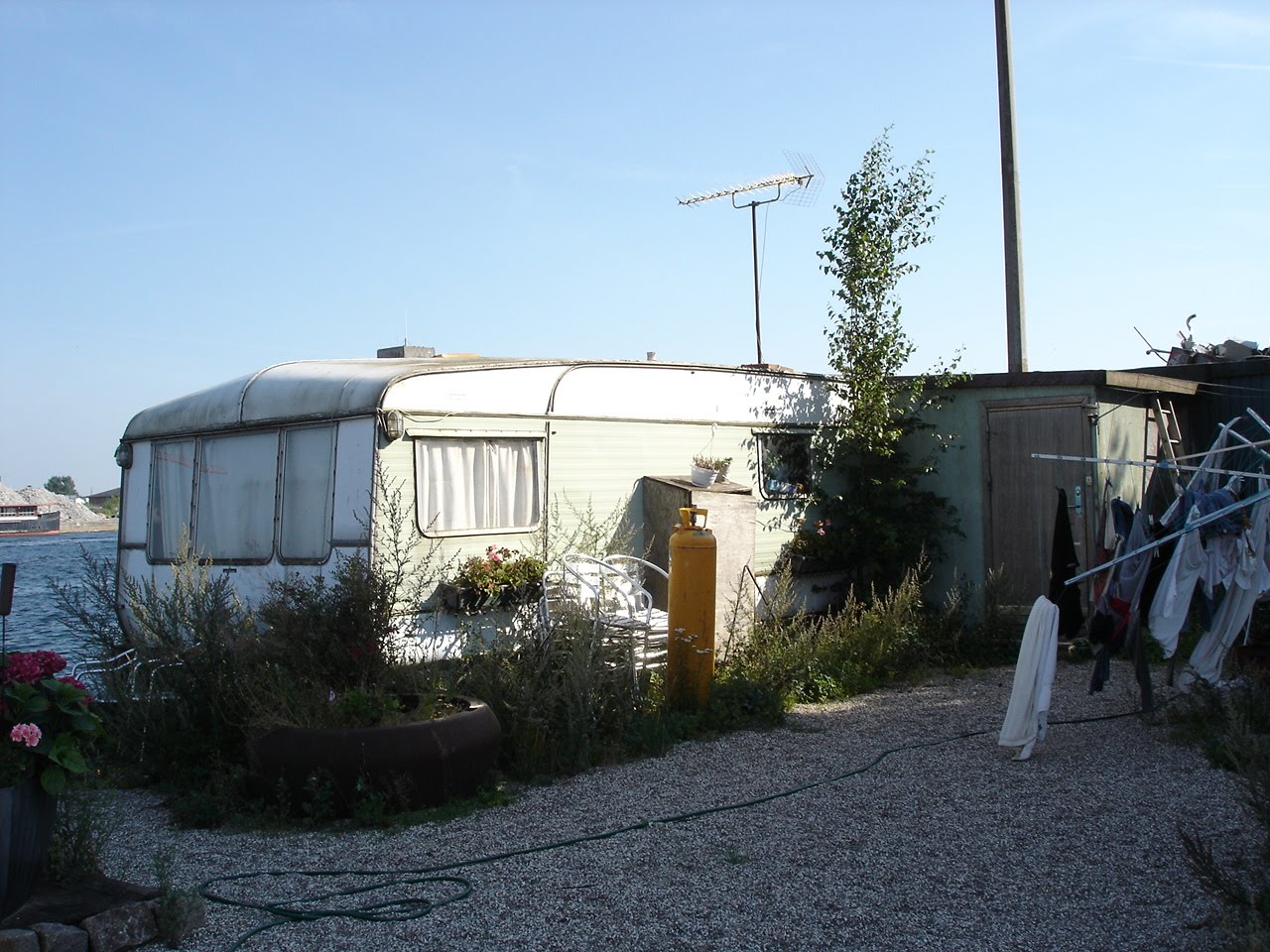
The first thing we saw after we went round the corner from the shopping centre was a trailer park of motorhomes. A nice detail was the way in which the concrete pigs had been domesticated by impregnated wooden fences.


We met Hartmut, who has a houseboat moored there, and heard from one of the other residents how land prices had shot up, about how the Port of Copenhagen has sold most of the waterside sites and is doing very little to ensure that there will be a lively harbour environment, and about how ownership rights to the waterside properties are rather complicated.


A little further out we saw this well trimmed lawn with a tower of refuse in the background from Uniscrap..


And a slightly more authentic trailer park atmosphere...


The view says something about the fact that this is where it’s at if one enjoys looking at cranes.


Even before we reached the graffiti wall, we could smell the spray paint – there was a lot of activity.


The soil is polluted everywhere out here, but it must be one of the most beautiful flowering meadows in the middle of Copenhagen.

søndag den 13. maj 2007

Nordhavn

Space is fundamental in any form of communal life. Space is fundamental in any excercise of power. Michael Foucault

Rumours are buzzing about holes in the fence cut by anglers, camping, self-built sheds, architecture like in the picture above and big investment plans.The area by Århusgade comes from landfills around 1900 and has functioned as a combined port and industrial area – for instance the harbour has housed Nordisk Film and the arms factory Dansk Industri Syndikat (The Rifle Syndicate), which was sabotaged during the Occupation.The large landfilled area north of the Free Port of Copenhagen was created with the reception of excavation fill over the last 30-40 years. Here we can still see the great hall that was used for casting the tunnel elements for the Øresund link.

Meeting-point: Nordhavn Station.
Date and time: Sunday, 13 May 2007, 12 pm.

It is perhaps appropriate to start with a strategy that doesn’t work; become part of the surroundings and sit quite still. The consequences of neoliberal urban development are becoming increasingly more obvious: standardisation and social imbalance. The most striking havens face the threat of being cleared by force, but just as many places are being subjected to an ongoing transformation into boring and lifeless suburban extensions.

Now and then the city offers a direct picture or caricature of contemporary developments: at the entry to Nordhavn we find a number of large pension companies, and those who are probably not insured on the other side of the tracks.

There are, however, still many places in Copenhagen that are different and special and have resisted the property market and normalisation. Nordhavn is one of them.

A good example of the unsentimental use of cheap materials. We thought that if it wasn’t eternit, it might well be asbestos sheets left over from a renovation.

Apple trees along the waterside

There were 10-12 of us on the walk – here leaving Kattegatvej. A large part of Nordhavn is industry and fencing. After 9/11 legislation in Denmark was also tightened to the benefit of the police and the detriment of civil rights. One of the measures was the increased screening off of ports and harbours. In certain places one can be charged under the anti-terror laws for climbing over a fence to find a good sport for fishing.

We met a resident of the area who was kind enough to let us in through a fenced-in area after having told us a little about Nordhavn. It is at present owned by the Port of Copenhagen and there is a local plan that stipulates that Nordhavn should be used for harbour-related activities. Some firms are here, however, even though they only import something or other that has nothing to do with the harbour. But if the municipality takes over, and the local plan is changed, anything could happen.

Between roughly 10 am and midday one can buy freshly caught fish – cod and plaice that are still wriggling. Go to the outer pier – it’s worth the walk.

torsdag den 29. juni 2006

Vestamager and mobile organic gardens

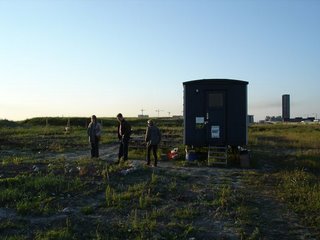
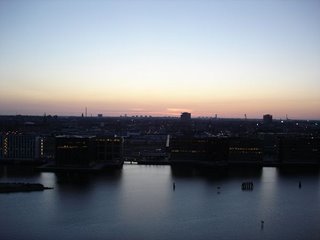
The next walk will be a dusk tour on Thursday, 29 June 2006. We shall start at 8.30 pm from the Vestamager metro station. Here we shall visit Ørestad’s mobile organic gardens and have a look at what else is going on in the district. The walk will end at Islands Brygge, where from the 13th floor at the top of a converted concrete silo one can get a view over the whole of Copenhagen, see the sun setting and giving a pink hue to Kødbyen’s white buildings from the Thirties, see the neon advertisements on City Hall Square emerge and catch a glimpse of Barsebäck’s grey silhouette if one so wishes. For the same reason: remember to bring binoculars!

The walk is organised together with Netværk for social og politisk kunst i offentlige rum [Network for Social and Political Art in Public Space].


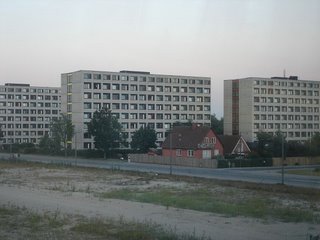
Vestamager is the end station on the metro line, and in the tradition for planning urban development with infrastructure the district will be densely built up in years to come. We saw the mobile organic gardens, where 99 lots can be rented for 200 kroner a year each. Every year the soil is harrowed, and the gardens are redistributed and can then be moved in step with the development of Ørestad.


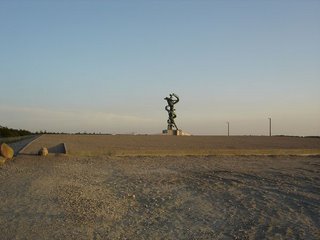
We continued to "Hein Heinsen’s Square", a sculpture that the Danish Arts Foundation’s Committee for Visual Arts has funded together with two other sculptures in Ørestad, all created by elderly Danish men.


The sculpture stands where the town ends and establishes a radical difference. In as much as it also resembles something that has been dropped out of the sky, it adds a new dimension to the concept of drop sculpture.


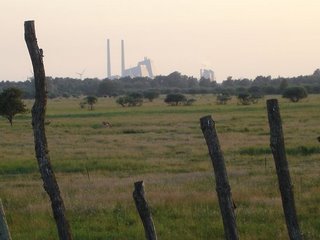
The Common is still one of the most unique free areas in Copenhagen. However, the Avedøre Power Station puts things in perspective and ensures that one does not feel brought back to the Golden Age of Danish painting.


The meeting between different kinds of housing, the natural surroundings and the city is one of Amager’s greatest qualities.


We ended on the roof of a silo by the waterfront, which has now been converted into apartments, one of the few places from which one has a view over the city.

Walked by:
Karen Lisbeth Kristoffersen and Hanne Lindstrøm from Netværk for social og politisk kunst i offentlige rum, Rikke Luther, Alec Due and Nis Rømer